 English
 Español
Contact Us For
One-Stop Service
One-Stop Service
Please fill in your detailed needs, our sales staff will revert to you shortly.
By Wenzhou Sing-rui International Trade Co., Ltd. | Published: March 2026
The global leather industry is at a crossroads. With consumers demanding sustainability and brands racing to meet ESG goals, a new category of materials has emerged: bio-based leather. But as with any fast-growing market, confusion abounds.
Is bio-based leather the same as vegan leather? Does "bio" mean biodegradable? And most importantly—can it perform like the real thing?
In this article, we cut through the greenwashing to examine corn-derived bio-based leather with 75% bio-content—what it is, how it's made, and why it's becoming the material of choice for forward-thinking brands across fashion, automotive, and home goods.
Bio-based leather refers to leather-like materials where a significant portion of the raw materials come from renewable biological sources—plants, agricultural waste, or other biomass—rather than fossil fuels.
This differs fundamentally from:
When we say our corn-based leather has 75% bio-content, we're making a specific, verifiable claim. This means that three-quarters of the material's mass comes from renewable sources—in this case, industrial corn.
The remaining 25% consists of:
This ratio represents the sweet spot in current material science: high enough to meaningfully reduce fossil fuel dependence, yet low enough to maintain the durability and workability that manufacturers demand.
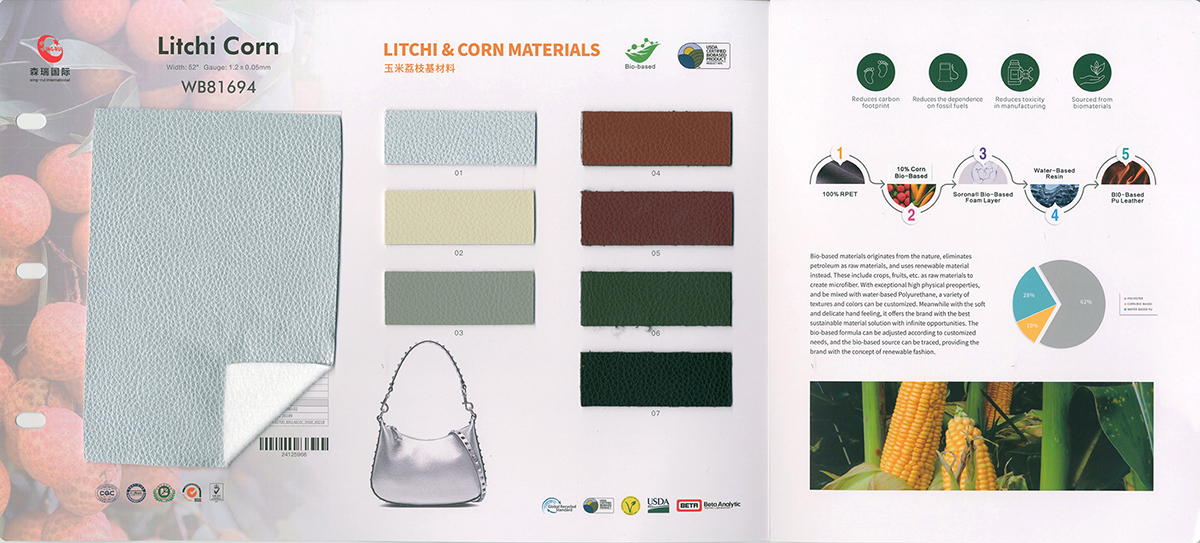
Our bio-based leather starts with industrial corn—not the sweet corn you eat, but field corn grown for industrial applications. Importantly, we use:
The transformation from corn to leather involves several sophisticated steps:
| Step | Process | What Happens |
|---|---|---|
| 1 | Extraction | Corn starch is extracted from industrial corn |
| 2 | Fermentation | Through precision fermentation, the starch is converted to bio-based PDO (1,3-propanediol) |
| 3 | Polymerization | PDO is polymerized into bio-based resin |
| 4 | Formulation | The resin is combined with other components |
| 5 | Coating | Applied to a durable backing material |
| 6 | Finishing | Textured, colored, and finished to achieve leather-like appearance |
This process replaces petroleum-derived polyols with plant-based alternatives, reducing reliance on fossil fuels while maintaining performance.
"Vegan leather" sounds ethical and sustainable. But in reality, most vegan leather is plastic-based.
According to industry data, the majority of vegan leather on the market today is:
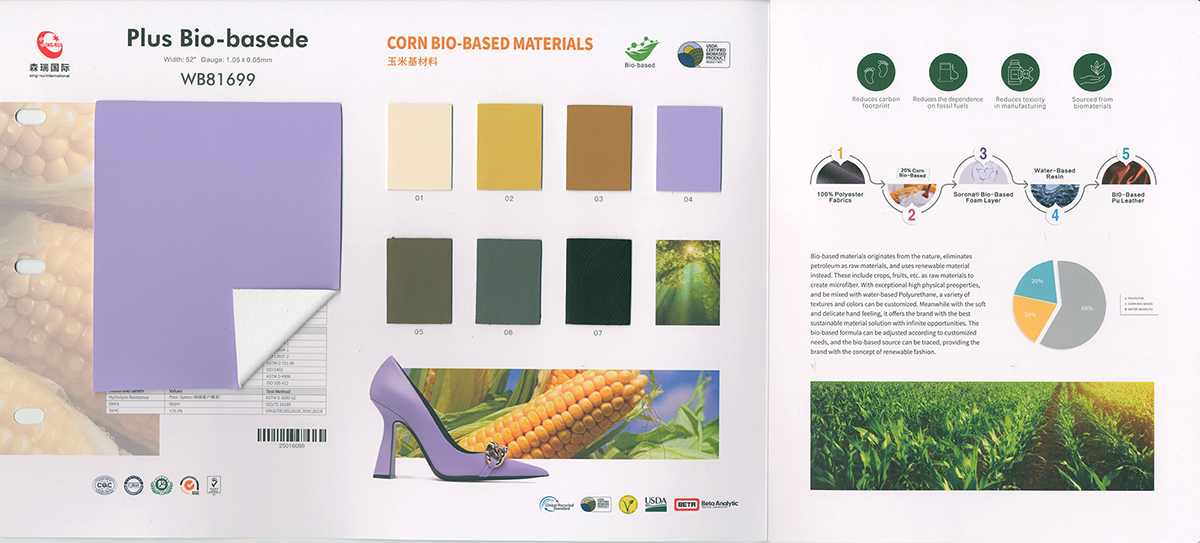
Our corn-based bio-leather represents a fundamental advance:
| Feature | Conventional Vegan Leather | Corn-Based Bio-Leather |
|---|---|---|
| Primary Source | Petroleum | Renewable corn |
| Bio-Content | 0% (unless specified) | 75% |
| Carbon Footprint | High (fossil fuel extraction) | Significantly lower |
| End of Life | Landfill (centuries) | Plant-based origin |
| Microplastic Risk | Yes | Reduced |
Google searches for "bio-based leather vs vegan leather" have surged in recent years. This isn't just curiosity—it's procurement teams and product developers realizing that not all animal-free materials are created equal.
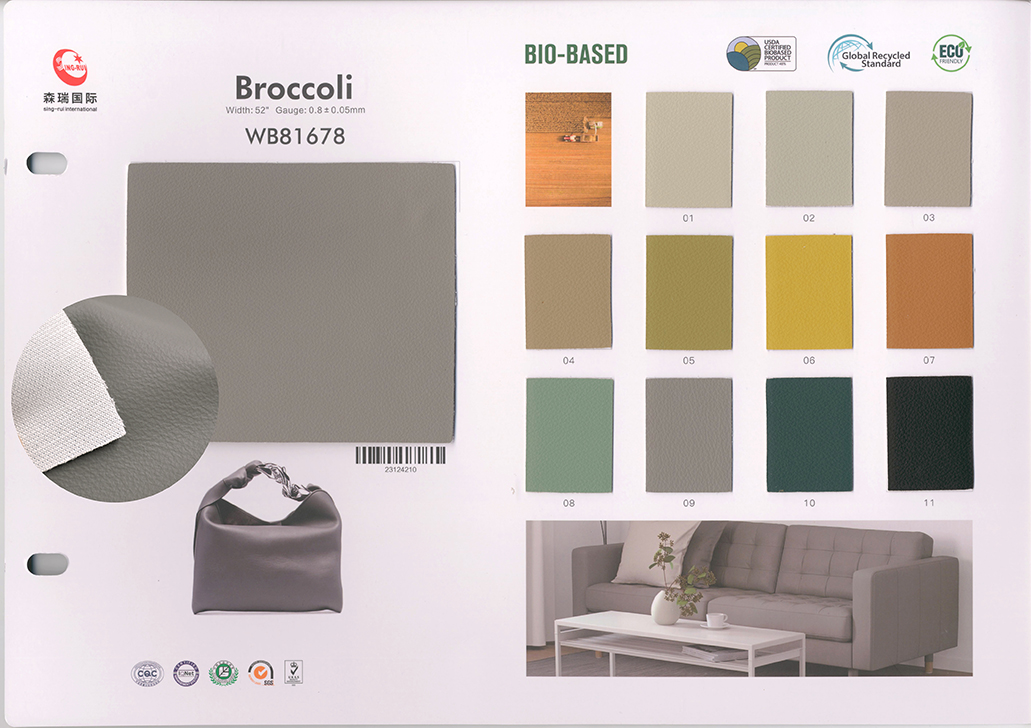
By replacing petroleum-derived components with plant-based alternatives, our 75% bio-content corn leather significantly reduces greenhouse gas emissions compared to conventional synthetic leather. This helps brands work toward their sustainability goals and ESG commitments.
Traditional cattle leather production requires vast amounts of water—approximately thousands of liters per hide. Our corn-based process uses a fraction of that, representing substantial water savings.
Unlike petroleum, which is finite and extracted from the earth, corn is a renewable resource that can be grown and harvested annually. This shift from fossil fuels to plant-based materials is fundamental to creating a more sustainable materials economy.
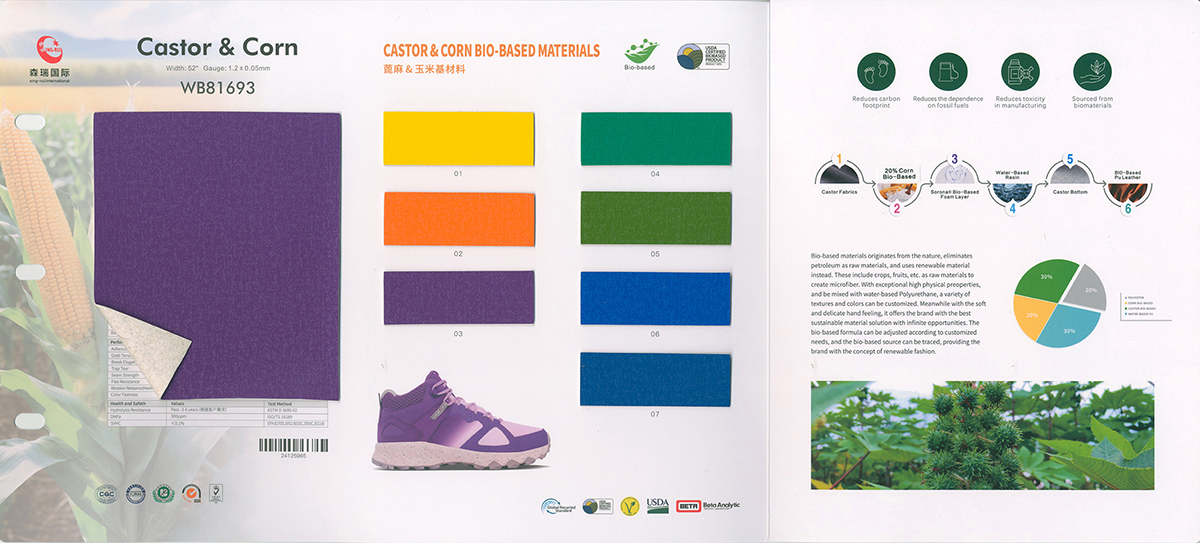
The most common concern we hear from manufacturers: "Will bio-based leather hold up in real products?"
Our corn-based bio-leather is engineered to meet the demands of commercial production:
| Property | Performance |
|---|---|
| Tensile Strength | Meets industry standards for footwear and bag manufacturing |
| Tear Strength | Suitable for everyday use in accessories and apparel |
| Abrasion Resistance | Designed for durability in finished products |
| Flexibility | Adapts to various design requirements |
Major automakers are actively exploring plant-based leather alternatives for vehicle interiors. Hyundai, for example, has partnered with biomaterials companies to develop plant-based leather, citing:
"Plant-based protein leather alternatives allow us to drastically lower environmental impact while meeting the demanding quality and performance standards of automotive interiors." — Hyundai
Similarly, Mercedes-Benz has developed bio-based leather alternatives combining sustainable materials, demonstrating that high-performance and sustainability can coexist.
From handbags to footwear, bio-based leather is gaining traction:
Our corn-based bio-leather is ideal for:
For manufacturers producing at scale, switching from petroleum-based synthetics to bio-based materials can significantly reduce environmental footprint while maintaining production efficiency.
The handbag market demands:
As the automotive industry accelerates toward carbon neutrality, bio-based materials are becoming strategic priorities:
The global bio-based PU leather market continues to grow, with automotive applications representing a significant segment.
For furniture manufacturers:
Unlike niche alternatives (mushroom, pineapple, cactus) that face supply limitations, our corn-based approach offers:
Our corn-based bio-leather is engineered for real-world use:
For manufacturers targeting international markets:
| Material Type | Source | Bio-Content | Scalability |
|---|---|---|---|
| Corn-Based (Ours) | Industrial corn | 75% | High—widely available |
| Mushroom (Mycelium) | Fungus | Varies | Limited—niche production |
| Pineapple (Piñatex) | Agricultural waste | Varies | Limited—geographic constraints |
| Cactus | Cactus plants | Varies | Limited—growing regions |
| Apple | Apple waste | Varies | Limited—seasonal |
| Recycled PU | Post-industrial waste | 0% | High |
Our corn-based approach prioritizes scalability and consistency—essential for manufacturers who need reliable supply chains.
When evaluating bio-based leather suppliers, verify:
| Question | Why It Matters |
|---|---|
| What is the exact bio-content percentage? | Anything under 50% may not qualify as "bio-based" for marketing |
| What is the source of the bio-material? | Corn, sugarcane, agricultural waste—each has different profiles |
| Does it compete with food supply? | Industrial byproducts are preferable to dedicated food crops |
| Can you provide samples? | Essential for evaluating quality |
| Is production scalable? | Important for volume manufacturing |
When you receive samples, evaluate:
Not necessarily. Bio-based refers to the origin of the material (renewable plants). Biodegradability refers to what happens at end of life. These are separate properties. Our focus is on the renewable origin of the material.
Each bio-based source has tradeoffs. Corn offers advantages in scalability and consistency—essential for manufacturers who need reliable supply chains. Mushroom and pineapple leathers are often limited in supply and higher in cost.
In many applications, yes. For products with moderate wear (handbags, casual shoes, upholstery), our corn-based bio-leather performs admirably. For extreme wear applications (heavy-use industrial), traditional leather may still be preferred.
The key is matching material to application—and our team can help you determine the best fit for your specific products.
Data suggests consumers value sustainability—within reason. Our corn-based bio-leather is priced competitively with premium synthetic leathers, making it an accessible sustainability upgrade rather than a luxury upcharge.
Simple messaging works best:
"Our products use 75% renewable, corn-based materials—reducing reliance on petroleum compared to standard synthetic leather. It's durable, consistent, and performs like the materials you're already using."
The global bio-based leather market is projected to grow significantly in the coming years, driven by:
| Region | Market Dynamics |
|---|---|
| North America | Largest market, driven by corporate sustainability programs |
| Europe | Strong regulatory push, particularly in automotive and fashion |
| Asia-Pacific | Fastest-growing, with China emerging as key producer and consumer |
The field is advancing rapidly, with new innovations emerging regularly. Our 75% bio-content material represents the sweet spot of today's technology—maximizing renewable content while ensuring performance and scalability.
The shift toward sustainable materials isn't a trend—it's a fundamental transformation of the leather industry. For manufacturers and brands, the question is no longer "if" to adopt bio-based materials, but "when" and "which."
Corn-based bio-leather with 75% bio-content offers:
✅ Verifiable renewable content — 75% from plant-based sources
✅ Proven performance — Suitable for commercial manufacturing
✅ Scalable supply — Consistent quality for volume production
✅ Consumer appeal — Authentic story that resonates with eco-conscious buyers
✅ Competitive positioning — Differentiate your products in the market
Whether you're producing footwear, handbags, or automotive interiors, bio-based materials deserve a place in your sourcing strategy.
Contact our team today to:
Website: www.sing-rui.com
Tags: bio-based leather, corn leather, sustainable leather alternative, vegan leather vs bio leather, plant-based leather, eco-friendly materials, footwear manufacturing, automotive interior materials, renewable materials